
Deadly Fringe Support Material


Program Evaluation and Analysis
2017 – 2024
Full report outlined below, downloadable link also available.
Deadly Fringe Program Evaluation and Analysis 2017-2024
Download Report Here"First Nations storytelling is a fundamental expansion of truth-telling, and the history and culture of Aboriginal and Torres Strait Islander peoples have been pushed toward silence and erasure. Using art forms as a means of achieving visibility, First Nations artists require effective platforms to broaden the reach and reception of what they create."
Bebe Backhouse, Deadly Fringe Program Review, 2024
Introduction
Over the past decade, Deadly Fringe has created a profound and lasting legacy, amplifying First Nations voices and deepening impact across the sector. Now in it’s tenth year, Deadly Fringe has grown into a self-sustaining, artist-led initiative, one grounded in trust, cultural integrity, and creative leadership.
Since its launch in 2017, Deadly Fringe has been a cornerstone of Melbourne Fringe’s commitment to First Nations artistic leadership and cultural equity. Designed to support emerging First Nations artists, producers, and audiences, the program provides both creative and financial support to develop and present new work. Through year-round support, industry connections, and a focus on self-determination, Deadly Fringe has created meaningful pathways for First Nations artists and artworkers to thrive.
Over the past ten years, the program has played a vital role in unearthing and championing bold new voices and perspectives. Leadership from our Deadly Fringe Producers and Coordinators has anchored and connected the program to community. As we look to the future, Deadly Fringe remains committed to fostering artistic excellence, commissioning new cohorts of First Nations artists, and strengthening opportunities for connection, visibility, and cultural celebration.
This report provides an overview of the program’s evolution and impact since its inception in 2017, including key achievements and the lasting legacy across the sector.
Program Overview
“Deadly Fringe is so important. First Nations Australian artists are at the cutting edge of art and performance making in this country. But we are also still dealing with the colonial legacies of cultural dislocation and poverty. So, whilst mainstream Australia has begun clamouring for us to make more and more work, we are still severely under-resourced and unsupported. Deadly Fringe is a vital link in the Melbourne arts ecosystem that combines financial investment with genuine and culturally appropriate support for local First Nations artists to make their work. Crucially, the festival context offered by Melbourne Fringe is one of the few opportunities available to Blackfella artists to get their work in front of audiences.”
Digby Mercer, Deadly Fringe Coordinator, 2021 - 2022
Since 2017, Deadly Fringe has been a vital platform for commissioning and presenting new performance and visual artworks by First Nations artists. Over this period, the program has supported the creation of 37 new works by 47 lead First Nations artists, boosting opportunities and significantly enhancing these artists' professional development. Many of these works have gone on to tour extensively and feature in festivals across the country, raising the profile of the artists involved and advancing their careers.
The program has tripled First Nations participation across Melbourne Fringe, strengthened connections with a broad network of First Nations artists and peer organisations, and forged enduring partnerships with cultural institutions including the Willin Centre, ILBIJERRI Theatre, and the Koorie Heritage Trust. These collaborations, alongside continued community engagement, have positioned Deadly Fringe as both a creative incubator and a connector across the arts ecosystem.
At the heart of the program is a belief in a self-determined arts ecology, one where First Nations artists are resourced to create, gain visibility, and engage with industry. Where presenters can access bold, high-quality work and where audiences are energised by stories rooted in culture and lived experience.
Deadly Fringe artists in the program are supported by a dedicated Deadly Fringe Coordinator, mentors, and a cultural consultant, who together offer a hierarchy of care, cultural support, and community connection. Artists also join a peer network and may participate in the Tour Ready program, which equips them to pitch their work to venues, presenters, and festival directors attending Melbourne Fringe.
Deadly Fringe Program Principles
Deadly Fringe is built around three guiding principles:
1. Deadly Fringe is a body of work.
Every year, the program commissions, develops, and presents a number of new works conceived and realised by First Nations artists. In the past, this has included new and existing small, medium, and large-scale events that span performance, visual art, design, and writing.
Building a body of work over time and placing it in the public sphere creates opportunities for additional First Nations creatives and producers by growing the ecology. The program focuses critical attention on the artworks, builds a consistent product for other presenters, fuels audience demand, and increases the visibility, profile, reputation, and awareness of First Nations artworks, artists, arts workers, and producers.
2. Deadly Fringe is a body of knowledge.
The program is guided by formal cultural safety guidelines, a Reconciliation Action Plan, and an annual training and self-assessment process for all non-Indigenous staff. This helps ensure that culturally appropriate practices and networks are a natural part of Melbourne Fringe’s everyday operations and makes sure that Aboriginal and Torres Strait Islander people feel safe, respected, and valued.
The governance of Deadly Fringe is overseen by board member Joel Bray and our ‘Hierarchy of Care’, which consists of senior producers who provide guidance to Melbourne Fringe as an organisation, and to First Nations staff.
3. Deadly Fringe is a body of connection.
The program connects Aboriginal and Torres Strait Islander artists. Professional and social gatherings provide opportunities for local creatives and production crews to meet. We’ve built strong relationships with key partners like the Koorie Heritage Trust, the Wilin Centre for Indigenous Arts & Cultural Development, ILBIJERRI Theatre Company, and Yirramboi Festival. These partners offer advice, support, and guidance to help artists fine-tune their work.
Deadly Fringe Activities
Across the program’s life, the shape and structure of Deadly Fringe has evolved to meet the needs of the community. These needs have been identified through the program’s evaluation processes, and strategies to meet these needs have been developed through consultation.
Deadly Fringe activities currently include:
Producing support. A dedicated Deadly Fringe Coordinator works year-round to support artists as they conceive, develop, and present their projects.
Commissions. Throughout the program's lifespan, Deadly Fringe has provided a variety of commissioning opportunities, from small-scale seed funding to large-scale presentations. In 2025-26, Deadly Fringe offers a tiered commissioning model, supporting a total of five projects of varying scale.
Mentorship. Commissioned artists are matched with an industry mentor (with a preference for First Nations mentors) to support the development of their work and their practice.
Microgrants. Deadly Fringe offers small grants for First Nations artists presenting works in Melbourne Fringe’s Open Access program, Design Fringe exhibition, or at Fringe Common Rooms.
Funding Deadly Fringe
Since its inception in 2017, Deadly Fringe has demonstrated how sustained public investment can support First Nations artistic leadership. Government support, particularly through the Indigenous Languages and Arts (ILA) program, has enabled Melbourne Fringe to establish the commissioning structures that sit at the heart of the program.
This investment has provided the stability required to commission and develop new work and has allowed Melbourne Fringe to leverage additional support from philanthropic donors and corporate partners. Together, these funding sources have expanded the scale and scope of Deadly Fringe, enabling the program to support artists working at multiple stages of their practice.
Through this blended funding model, Deadly Fringe offers a range of commissioning opportunities, from early-stage creative development and seed funding to larger presentation commissions. This tiered approach ensures that artists at different points in their careers can access meaningful support, whether they are testing new ideas or realising ambitious new works for presentation.
By combining public investment with philanthropic and corporate contributions, Deadly Fringe has increased the total resources available to First Nations artists while maintaining a strong commitment to self-determined and culturally supported creative practice.
Program Achievements and Impact
- Building a Body of Work
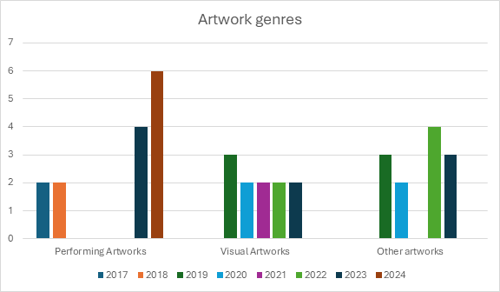
From 2017 to 2024, Deadly Fringe commissioned or directly supported 37 works by 47 lead First Nations artists. Between 2017 and 2024, Deadly Fringe supported the creation and presentation of 37 artworks, including 14 major performance works and 11 visual art commissions. The program also enabled the presentation of 12 additional works by First Nations artists through partnerships and co-presentations. In total, 47 lead artists have been supported, with participation more than doubling in some years as the program expanded.
Across eight years, 689 First Nations artists have participated in the Festival, growing from just 45 artists in 2017 to a peak of 131 in 2022. While the total number of First Nations artists has varied year to year, Deadly Fringe has consistently contributed to a higher profile and greater participation across the Festival as a whole.
Representation as a share of all participating artists increased from 1.47% in 2017 to a high of 6% in 2020, averaging approximately 3.8% across the eight-year period.
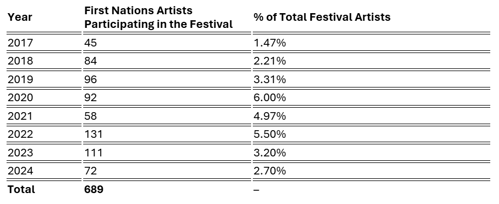
We initially aimed for 5% participation, which was ambitious considering First Nations people have historically made up 2-3% of Australia's total population. We have consistently surpassed the general workforce level of .88% and the arts industry average of 2.1% for First Nations participation. Notably, the rising number of applications from First Nations artists through our general rounds, not just the Deadly Fringe Commissions, indicates that artists view the Melbourne Fringe as a safe and supportive space.
The program has played a key role in launching significant First Nations-led works. Joel Bray's Biladurang, rooted in Wiradjuri storytelling, premiered at Melbourne Fringe and toured major festivals like Darwin, Brisbane, Sydney, and Auckland. Sandy Greenwood's Matriarch, a one-woman show about Gumbaynggirr women, received acclaim at the 2018 Melbourne Fringe and won a Green Room Award before touring to Adelaide and Los Angeles. Declan Furber Gillick's Bighouse Dreaming, a critique of the youth justice system, was developed with Deadly Fringe's support and presented at the 2021 YIRRAMBOI Festival at Arts Centre Melbourne. Na Djinang Circus's Of The Land On Which We Meet, blending acrobatics and storytelling, has toured extensively across Victoria, with shows in Wodonga and Bendigo, and to Edinburgh.
In building a body of work, other key outcomes include:
Professional Pathways: The program has provided strong and supported pathways for early and mid-career First Nations artists to develop, present, and professionalise their work. Artists have had the opportunity to gain paid experience and visibility at a major arts festival, a rare and valuable platform for emerging talent.
Artist-Led Practice: Artists maintain creative control across all aspects of their project, including timelines. This self-determined approach ensures culturally safe and artist-centred processes, where creative risk-taking is welcomed and failure is understood as part of artistic development.
Partnerships and Industry Connections: We have brokered impactful partnerships between artists and venues, producers, donors, and creative collaborators, amplifying the reach and sustainability of their work.
Embedded Cultural Support: Artists are supported by a Deadly Fringe Coordinator who provides ongoing cultural guidance, alongside mentorship and producing expertise from the Melbourne Fringe team.
Trust and Continuity: The strength of Deadly Fringe lies in the trust we’ve built with artists and communities. That trust has been earned over time and is upheld through ongoing dialogue, care, and respect for the diverse needs of the artists we work with.
Together, these outcomes have contributed to a healthier, more inclusive arts ecology. One where First Nations artists are supported not just to participate, but to lead, take risks, and thrive.
2. Building a Body of Knowledge
As Deadly Fringe has evolved, so too has our understanding of what it means to work alongside and within First Nations-led arts practice. Beyond the creation and presentation of artworks, the program has actively contributed to building a body of knowledge within our organisation, across the sector, and among the artists and producers we’ve supported.
In building a body of knowledge, key outcomes include:
Investing in First Nations Producers: We have employed and nurtured 13 First Nations producers, pairing them with senior producing mentors both within and outside of Melbourne Fringe. This investment has helped build a pipeline of culturally informed creative producers with the confidence, networks, and skills to lead projects and support peers.
Improving Cultural Safety and Awareness: Through internal training, policy refinement, and reflective practice, we’ve strengthened our cultural competency as an organisation. While we acknowledge there is still significant work to do, this process has laid the groundwork for a more culturally safe and responsive environment.
Clarifying Our Role in the Sector: We’ve increasingly recognised the need to distinguish between the work we should lead and the work that First Nations organisations best lead. We’ve shifted toward outcome-based programming, focusing on artistic development and presentation, while stepping back from community connecting work that is more appropriate for peer organisations to lead.
Collaborating with the Broader Ecology: Deadly Fringe has contributed to growing the broader First Nations arts ecology by shouldering some of the responsibility for artist development, in parallel with First Nations-led organisations. We’ve aimed to complement, not replicate, their work, supporting growth through collaboration rather than competition.
Learning Through Doing: We’ve made mistakes, and we’ve learned from them. The program has been adaptive and reflective, responding to shifting cultural conversations and the pace of social progress with openness and humility.
Through these experiences, Deadly Fringe has not only created new opportunities for artists but has also helped Melbourne Fringe become a more accountable, knowledgeable, and future-focused organisation.
3. Being a Connecting Body
Throughout the project, Deadly Fringe has solidified its role as a vital body of connection, bringing together First Nations artists, arts workers, and cultural organisations in meaningful and sustained ways. The program has fostered new artistic collaborations, strengthened existing networks, and created pathways for knowledge sharing and cultural exchange. From informal meetups to structured professional gatherings, we’ve seen a growing sense of trust, solidarity, and momentum among participants. These moments have sparked new ideas, affirmed cultural identity, and provided a crucial space for participants to feel seen, supported, and connected.
One of the key learnings has been the importance of holding space for community-led connection on its own terms. Rather than positioning ourselves as the central hub, we’ve aimed to facilitate relationships that continue beyond the life of any single event or program. Through our partnerships with organisations like the Koorie Heritage Trust, the Wilin Centre, ILBIJERRI, and Yirramboi, we’ve created a network of support that artists can draw on at different stages of their practice.
Challenges and Learnings
Our work in this space has underscored just how complex and sensitive the terrain is. As an organisation, we recognise that many Australians have not yet fully reckoned with the truths of colonial dispossession, the ongoing displacement of Aboriginal and Torres Strait Islander peoples, and the deep, intergenerational impacts of cultural, familial, and linguistic loss that stem from the loss of Country. Melbourne Fringe staff members are each on their own journey of learning and unlearning, and we have found that the most critical factor is a collective willingness to listen, be challenged, and change.
From the outset, we prioritised cultural competency by engaging in foundational training through Marrang training at the Wilin Centre. This included challenging myths and assumptions, broadening our understanding of what it means to be an Aboriginal person, and learning to better recognise and respect urban Indigenous identities. While we now demonstrate cultural competency in many aspects of our work with First Peoples, we know this is ongoing, evolving work. There is much more to learn and to embed meaningfully into our systems and structures.
One of the most persistent barriers, for Melbourne Fringe and the sector more broadly, has been a fear of getting it wrong. Developing confidence in navigating cultural protocols has taken time, mistakes, reflection, and repair. We've come to understand that the ‘right way’ is not fixed and that our role continues to evolve. Remaining open to guidance and change has been essential.
Engaging with Elders continues to be a challenge. While we have found meaningful opportunities to include welcoming ceremonies at the start of our Festival, building deeper relationships has been limited by several factors, particularly the significant and growing demands on Elders’ time, and the fact that none of our Deadly Fringe Coordinators to date have been from the local area. Despite this, Elders know us and know our work, and we continue to seek respectful, sustainable ways to strengthen these relationships.
Legacy and Long-Term Impact
The long-term impact of Deadly Fringe lies not just in the number of works presented or artists supported, but in the strength of the model itself - a model that actively embodies self-determination, cultural safety, and artist-led practice. This is a program built on trust, flexibility, and respect. Its legacy is in the space it has created for First Nations artists to take full control of their creative journeys, defining the content, pace, process, collaborators, venues, and timelines that best align with their artistic and cultural values.
By centering process over product, Deadly Fringe has redefined what success looks like in an arts context. Sometimes that has meant holding space for artists who, due to personal or global challenges such as COVID, needed time away or were unable to complete a project. At other times, it has meant being prepared to take the risk of backing bold, career-defining works that have gone on to tour nationally, earn critical acclaim, and shift the mainstream narrative around First Nations art.
Deadly Fringe has laid the foundation for a future where supporting First Nations artistic leadership is not just the job of First Nations peer organisations, but a responsibility willingly and equally shared by non-Indigenous arts organisations like Fringe. We've come from a context where First Nations arts were under-represented in Australia's mainstream venues and festivals, and almost half of Australian presenters did not program works with First Nations creative control, involvement, or content. By being willing to take risks and nurture emerging artists, Deadly Fringe has made a profound contribution to changing this dynamic – launching careers, fostering partnerships, and sparking a cultural shift not just across Melbourne Fringe but across the broader arts landscape.
Looking Ahead
As Deadly Fringe celebrates its tenth anniversary in 2026, the program stands as a self-sustaining, artist-led model, a rare and powerful example of long-term impact and cultural leadership. But our work with Deadly Fringe is not finished. Our role will continue to respond and change as we deliver the next iteration co-designed with First Nations artists and producers.
In 2026, to mark a decade of Deadly Fringe, we are proud to launch our most ambitious project to date: a $150,000 major commission at Fed Square, designed to centre First Nations voices and stories in the heart of the city. This new commission will create a high-profile platform for an experienced First Nations artist, placing their work as the centrepiece of the Festival and deepening public engagement with the stories, perspectives, and practices that Deadly Fringe was built to elevate.
Looking forward, we’re excited to continue evolving the program, supporting a new generation of artists, expanding our reach, and refining how we work in deep collaboration with the community, partners, and the broader sector. The first ten years of the program have laid a remarkable foundation, and the following ten promise even more.